




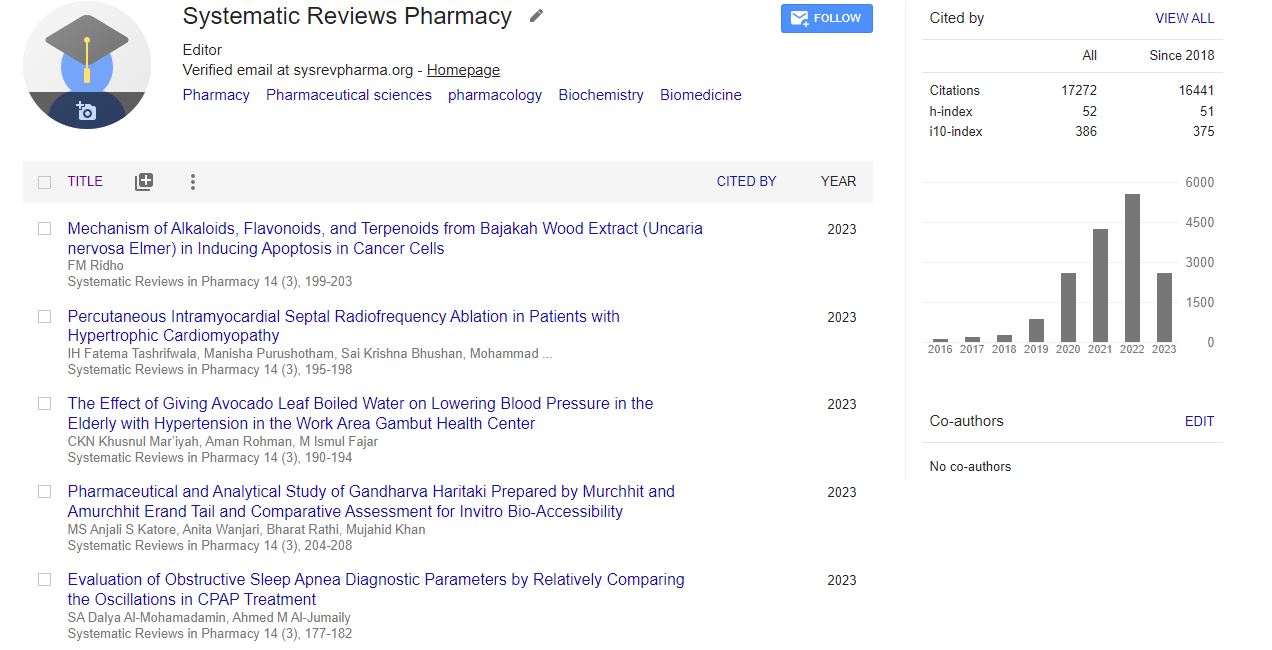
Google Scholar citation report
Citations : 25586
Systematic Reviews in Pharmacy received 25586 citations as per google scholar report
Systematic Reviews in Pharmacy peer review process verified at publons

Indexed In
Commentary Article - (2026) Volume 17, Issue 1
Modulated use of CVVH with oXiris: A rational therapeutic option after surgery in perforated bowel patients with septic shock and initial MODS
Paolina Saullo1, Daniel Nalli2 and Piero Chirletti1*Description
Abdominal sepsis secondary to colonic perforation, represents one of the most severe intra-abdominal infections in critically ill surgical patients. Massive contamination of the peritoneal cavity by enteric bacteria, and the early release of anaerobic endotoxins into the bloodstream represents the triggers a rapid amplification of the systemic inflammatory response.
The large absorptive surface of the peritoneum and its rich vascular supply facilitate the early systemic dissemination of anaerobic bacteria and high concentrations of pro-inflammatory mediators, including IL-2, IL-6, IL-8, and TNF-α.
These mediators cause a Systemic Inflammatory Response Syndrome (SIRS) that is often disproportionate to the primary infectious focus. Due to this evolution the early Multiple Organ Dysfunction Syndrome (MODS) represents the main adverse prognostic factor associated with high mortality rates, reaching 30-50% in the most severe cases.
In this setting, the source surgical control takes on an indispensable healing value. Resection of the colonic perforation, eradication of the septic focus, meticulous peritoneal lavage and drainage of the anatomical recesses constitute the cornerstone upon which any subsequent chance of clinical recovery depends. No patient lives without source infection control.
Without early and adequate surgical procedure, any medical or extracorporeal therapeutic strategy is destined to remain insufficient However, you need to underlined that radical, surgery alone fails to interrupt the cytokine storm triggered by sepsis. To avoid the systemic effects due to circulating endotoxins and inflammatory mediators, is need of continuous hematic clearing and replacement.
For this reason, early implementation of a modulated continuous hemofiltration strategy, using the oXiris filter should be considered, following surgical resection of the perforated colon in patients with onset hemodynamic shock, as the better therapeutic choice for to treat the organ dysfunction, lactic acidosis, acute kidney injury, or persistent septic metabolic derangement.
In addition to bowel resection, surgical management should include extensive peritoneal lavage with more than 5 liters of warmed lactated ringer’s solution at 37°C, aimed at thoroughly cleansing the abdominal cavity and the main anatomical recesses, including the douglas pouches, the right and left paracolic gutters, and both subphrenic spaces. In this context, Modulated Continuous Veno-Venous Hemofiltration (CVVH) offers a relevant advantage compared with other replacement modalities. Continuous extracorporeal purification has limited hemodynamic impact in critically ill patients and allows dynamic adjustment of ultrafiltration and reinfusion volumes according to the patient’s clinical and hemodynamic status.
In this setting the rationale use of oXiris filter is further supported by recent literature on severe intra-abdominal sepsis (Zhou Y, et al., 2025; Li Y, et al., 2022). In a retrospective cohort of patients with severe abdominal infection treated with Continuous Renal Replacement Therapy (CRRT), the use of the oXiris filter was associated with more rapid improvement in lactate levels, norepinephrine requirements, and reductions in IL-6 levels, APACHE II score, and SOFA score compared with conventional CRRT. Also, the 28-day mortality was lower in the oXiris-treated group. In the same study, each hour of delay in source control was associated with a 9.6% increase in 28-day mortality, confirming that extracorporeal blood purification does not replace surgery but may represent a biologically rational adjunct during the earliest and most unstable phases of the disease.
Our previous experience with CVVH using the oXiris filter in 48 patients with early severe acute pancreatitis complicated by severe hemodynamic compromise, MODS, and sepsis refractory to initial intensive care measures further encouraged us to extend this strategy to patients with abdominal sepsis secondary to intestinal perforation (Saullo P, et al., 2025).
In that cohort, treatment was well tolerated in all patients, with a 28-day survival rate of 97.9%, a significant time-dependent reduction in IL-6 and TNF-α levels in the ultrafiltrate, and a marked decrease in APACHE II score from the immediate postoperative period to the second postoperative week, suggesting a possible immunomodulatory effect of the technique.
Based on this experience, we applied Modulated CVVH using the oXiris filter in five patients with severe abdominal sepsis: Three cases of fecal peritonitis due to Hinchey IV acute diverticulitis, one case of gastrojejunal anastomotic perforation following total pancreatectomy, and one case of acute intestinal obstruction with bacterial translocation associated with valproic acid intoxication.
In all cases, after surgery and transfer to the intensive care unit under invasive multiparametric monitoring, respiratory support, and hemodynamic support, early modulated CVVH with oXiris was initiated. The concentration of inflammatory proteins particularly IL-6 and TNF-α endotoxins, and, in the specific case, toxic metabolites of valproic acid in the effluent was compared with corresponding blood values and correlated with serum creatinine levels, recovery of urine output, clinical course, and hemodynamic parameters.
Preliminary results showed a pattern consistent with that reported in the literature, with progressive reduction of the extracorporeal inflammatory and toxic burden and parallel clinical and metabolic improvement (p<0.01). Specifically, we observed an early reduction in vasopressor requirements (78% decrease within 48 hours), a trend toward normalization of lactate levels within 48-72 hours, a decrease in serum creatinine associated with recovery of spontaneous diuresis and attenuation of MODS, as documented by improvement in clinical and prognostic parameters, including a reduction in SOFA score ≥ 2 points within the first 48 hours and normalization within two weeks after surgery.
Conclusion
In conclusion, in patients with severe peritoneal sepsis due to intestinal perforation, early use of modulated CVVH with the oXiris filter should be strongly considered after adequate surgical source infection control, transfer to the intensive care unit a start of invasive multiparametric cardiorespiratory support. Even in the presence of initial hemodynamic instability-which may only apparently contraindicate continuous hemofiltration- this strategy may represent a rational therapeutic option to reduce endotoxin and cytokine burden, promote metabolic stabilization and limit the progression of MODS during its earliest and potentially reversible stages.
Acknowledgment
Authors declare no conflicts of interest
References
- Zhou Y, Liu MJ, Lin X, Jiang JH, Zhuo HC. Comparative efficacy of two hemopurification filters for treating intra-abdominal sepsis: A retrospective study. Chin J Traumatol. 2025;28(5):352-360.
[CrossRef] [GoogleScholar] [PubMed]
- Li Y, Sun P, Chang K, Yang M, Deng N, Chen S et al. Effect of continuous renal replacement therapy with the oXiris hemofilter on critically ill patients: A narrative review. J Clin Med. 2022;11(22):6719.
[CrossRef] [GoogleScholar] [PubMed]
- Saullo P, Caronna R, Angelici AM, Rinaldi V, Liberatori G, Mingoli A, et al. Value of continuous hemofiltration in patients with severe acute pancreatitis at onset: Single centre experience on 48 patients. J Clin Med. 2025;14(18):6647.
[CrossRef] [GoogleScholar] [PubMed]
Author Info
Paolina Saullo1, Daniel Nalli2 and Piero Chirletti1*2Department of Anesthesiology, Critical Care Medicine and Pain Therapy, Policlinico Umberto I Hospital, Rome, Italy
Citation: Saullo P: Modulated Use of CVVH with OXiris: A Rational Therapeutic Option After Surgery in Perforated Bowel Patients with Septic Shock and Initial MODS
Received: 09-Mar-2026, Manuscript No. srp-26-186226; , Pre QC No. srp-26-186226 (PQ); , Pre QC No. srp-26-186226 (PQ); , QC No. srp-26-186226; Revised: 25-Mar-2026, Manuscript No. srp-26-186226 (R); Published: 08-Apr-2026, DOI: 10.31858/0975-8453.17.1.400-401
Copyright: This is an open access article distributed under the terms of the Creative Commons Attribution License, which permits unrestricted use, distribution, and reproduction in any medium, provided the original work is properly cited.
ARTICLE TOOLS
 Abstract
 How to cite this article
- Dental Development between Assisted Reproductive Therapy (Art) and Natural Conceived Children: A Comparative Pilot Study Norzaiti Mohd Kenali, Naimah Hasanah Mohd Fathil, Norbasyirah Bohari, Ahmad Faisal Ismail, Roszaman Ramli SRP. 2020; 11(1): 01-06 » doi: 10.5530/srp.2020.1.01
- Psychometric properties of the World Health Organization Quality of life instrument, short form: Validity in the Vietnamese healthcare context Trung Quang Vo*, Bao Tran Thuy Tran, Ngan Thuy Nguyen, Tram ThiHuyen Nguyen, Thuy Phan Chung Tran SRP. 2020; 11(1): 14-22 » doi: 10.5530/srp.2019.1.3
- A Review of Pharmacoeconomics: the key to “Healthcare for All” Hasamnis AA, Patil SS, Shaik Imam, Narendiran K SRP. 2019; 10(1): s40-s42 » doi: 10.5530/srp.2019.1s.21
- Deuterium Depleted Water as an Adjuvant in Treatment of Cancer Anton Syroeshkin, Olga Levitskaya, Elena Uspenskaya, Tatiana Pleteneva, Daria Romaykina, Daria Ermakova SRP. 2019; 10(1): 112-117 » doi: 10.5530/srp.2019.1.19
- Dental Development between Assisted Reproductive Therapy (Art) and Natural Conceived Children: A Comparative Pilot Study Norzaiti Mohd Kenali, Naimah Hasanah Mohd Fathil, Norbasyirah Bohari, Ahmad Faisal Ismail, Roszaman Ramli SRP. 2020; 11(1): 01-06 » doi: 10.5530/srp.2020.1.01
- Manilkara zapota (L.) Royen Fruit Peel: A Phytochemical and Pharmacological Review Karle Pravin P, Dhawale Shashikant C SRP. 2019; 10(1): 11-14 » doi: 0.5530/srp.2019.1.2
- Pharmacognostic and Phytopharmacological Overview on Bombax ceiba Pankaj Haribhau Chaudhary, Mukund Ganeshrao Tawar SRP. 2019; 10(1): 20-25 » doi: 10.5530/srp.2019.1.4
- A Review of Pharmacoeconomics: the key to “Healthcare for All” Hasamnis AA, Patil SS, Shaik Imam, Narendiran K SRP. 2019; 10(1): s40-s42 » doi: 10.5530/srp.2019.1s.21
- A Prospective Review on Phyto-Pharmacological Aspects of Andrographis paniculata Govindraj Akilandeswari, Arumugam Vijaya Anand, Palanisamy Sampathkumar, Puthamohan Vinayaga Moorthi, Basavaraju Preethi SRP. 2019; 10(1): 15-19 » doi: 10.5530/srp.2019.1.3